Celestial Dog Names: 100+ Star, Moon & Space Ideas
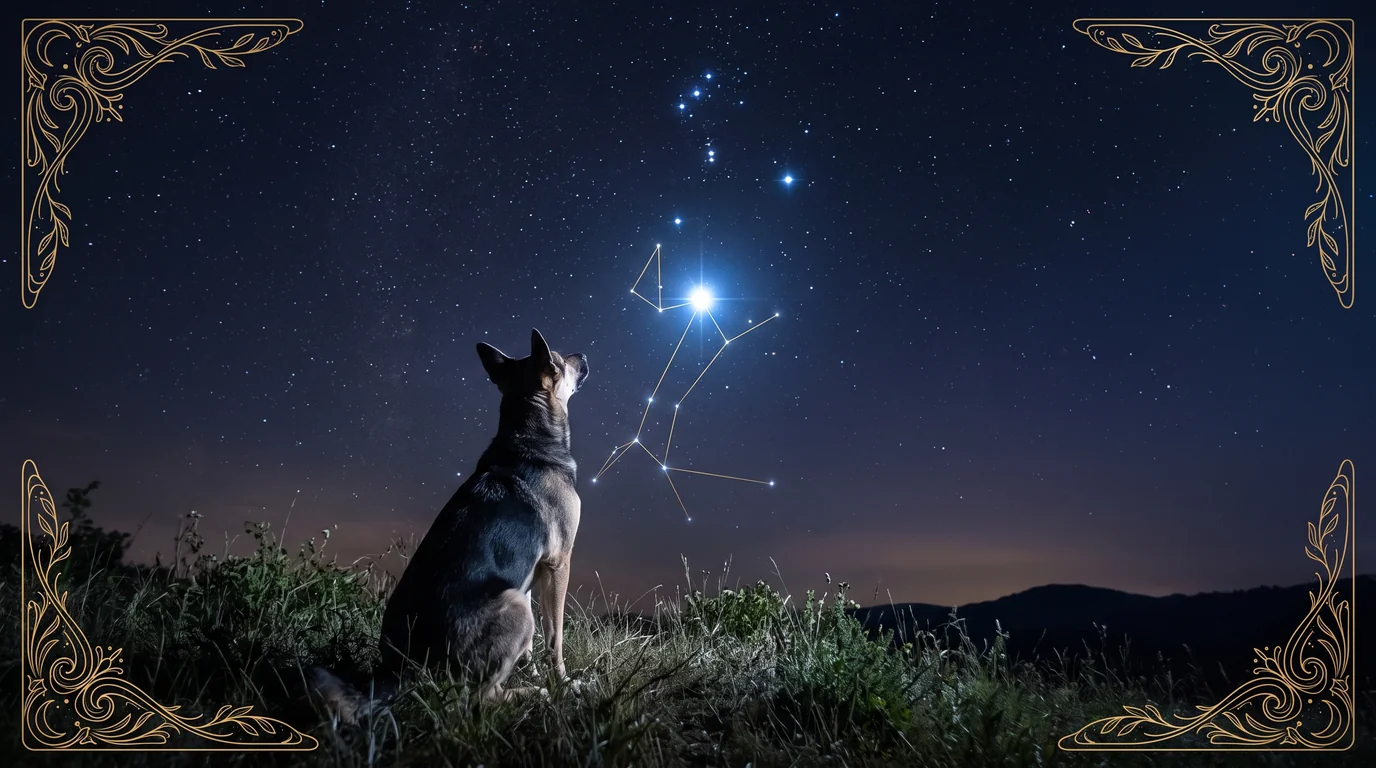
Celestial dog names have an unfair advantage over every other kind: the sky is already full of dogs. There's a Great Dog and a Little Dog, two hunting dogs, a wolf and a fox, and a mythical hound that never lost a chase. There are also the real dogs who flew to space before any human did. This list starts there, then moves out to the Moon, the named stars, meteor showers and astronauts. 100+ names, with quick picks for girls and boys.
One thing first. If you want Sirius, the Dog Star itself, or names chosen by your dog's zodiac sign, those are in our astrology dog names list, and none of them are repeated here. This page is about the sky itself, so everything below is new.
Female & Male Celestial Dog Names: Quick Picks
Ten from each side of the list, if you just want a shortlist to say out loud in the kitchen. Every one is explained further down.
For female dogs: Adhara · Laika · Belka · Strelka · Lucina · Tsuki · Hina · Merope · Vesta · Valentina
For male dogs: Mirzam · Wezen · Laelaps · Hati · Canopus · Leonid · Dezik · Yuri · Buzz · Leonov
The Dogs Already in the Sky
Sirius gets all the attention, but it doesn't sit in the sky alone. It's the brightest star of Canis Major, the Great Dog, a constellation that really does look like a dog standing on its hind legs if you squint on a winter night. The other stars in that dog have names too, and almost nobody uses them.
- Adhara — the second-brightest star of the Great Dog, at its hind leg
- Wezen — a supergiant thousands of times brighter than the Sun, the dog's body
- Mirzam — "the herald": it rises just before Sirius and announces it
- Aludra — the star at the tip of the Great Dog's tail
- Muliphein — the faint star at the Great Dog's ear
- Furud — a faint star below the dog's hind paws
- Canicula — "little dog", the old Latin name for Sirius; "Nicky" for short
- Gomeisa — the second star of Canis Minor, the Little Dog
- Maera — the faithful dog of Greek myth, placed in the sky as the Little Dog in one telling
- Laelaps — the mythical hound that never failed to catch what it chased
- Asterion — one of the two hunting dogs of Canes Venatici
- Chara — the other hunting dog; Greek for "joy"
- Caroli — after Cor Caroli, "Charles's heart", the brightest star of the hunting dogs
- Lupus — the Wolf, a southern constellation near Scorpius
- Vulpecula — the Little Fox; perfect for a red, pointy-eared dog
The Dogs Who Went to Space
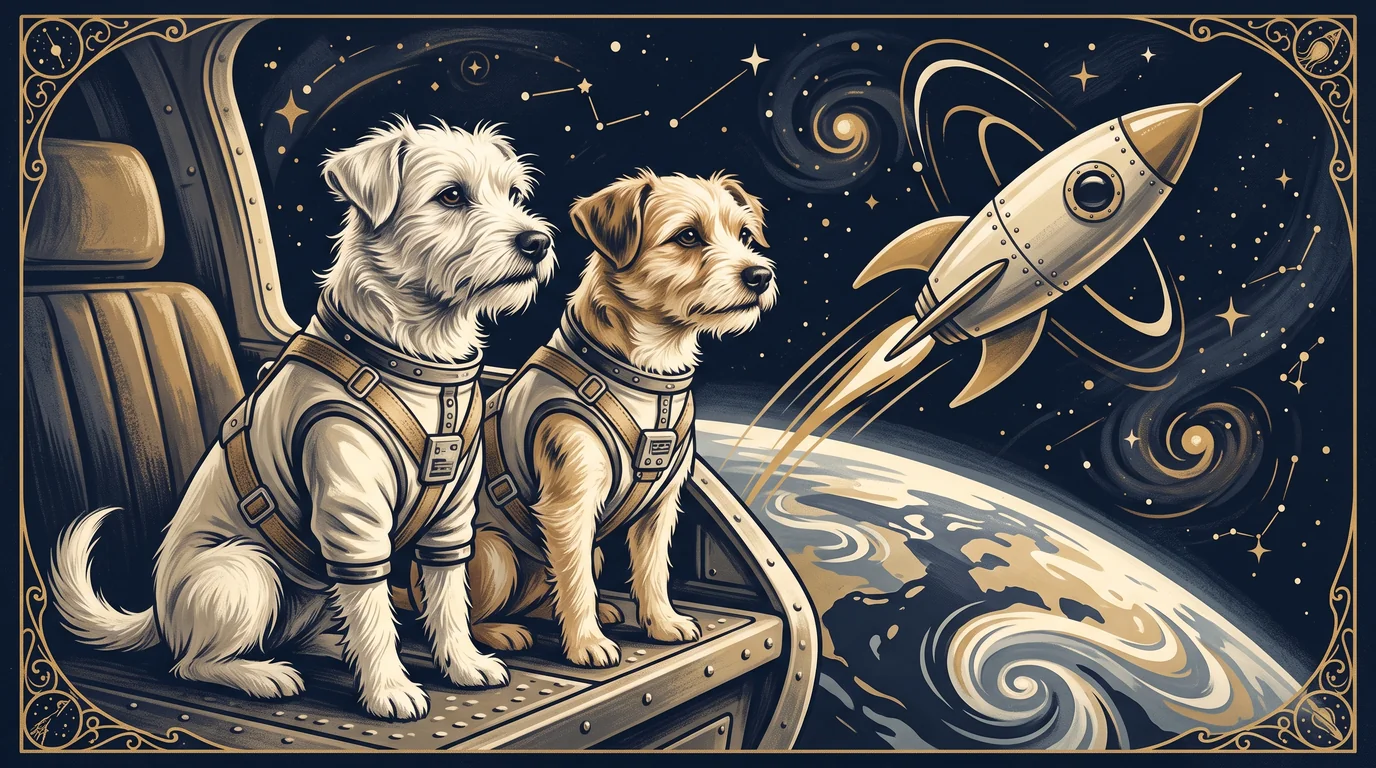
Before Yuri Gagarin, the Soviet space program flew dogs. They were mostly strays from the streets of Moscow, chosen because a dog that had survived winters outside was thought to be tough, and small enough to fit the capsule. Their names are some of the best dog names ever given, and they come with a real story attached. Not all of those stories end well, and it's worth knowing which before you choose one.
- 1951Dezik & TsyganA suborbital flight to the edge of space, and both dogs recovered alive. Tsygan, "Gypsy", was adopted by one of the scientists afterwards; Dezik died on a second flight later that year.
- 1957LaikaThe first animal to orbit Earth, aboard Sputnik 2. She did not survive the flight. Her name means "barker".
- 1960Belka & Strelka"Squirrel" and "Little Arrow": the first dogs to go into orbit and come home alive, a day later, alongside the mice, rats and plants that flew with them.
- 1961Pushinka"Fluffy", one of Strelka's puppies, given by Nikita Khrushchev to Caroline Kennedy. She lived at the White House.
- 1961Chernushka & ZvezdochkaThe two dogs who flew the final test missions before Gagarin. Zvezdochka means "little star"; the name is usually credited to Gagarin himself.
- 1966Ugolyok & Veterok"Little Coal" and "Breeze": 22 days in orbit, a record for dogs, and both returned.
- Laika — the first animal in orbit
- Belka — "squirrel"; came home
- Strelka — "little arrow"; came home and had puppies
- Pushinka — "fluffy"; the space dog's daughter who moved to the White House
- Zvezdochka — "little star"; "Zvezda" for every day
- Chernushka — "blackie"; flew with a mannequin cosmonaut for company
- Ugolyok — "little coal"; perfect for a black dog
- Veterok — "breeze"
- Dezik — the first dog recovered from space, in 1951
- Tsygan — his co-pilot, who retired to a scientist's home
Moon Names for Dogs
Dogs howl at the Moon in every cartoon ever drawn, and in Norse myth it's worse: two wolves, Hati and Sköll, chase the Moon and the Sun across the sky, and the day Hati catches the Moon is the end of the world. That's a lot of pressure for a name, but it suits a dog who has never once stopped chasing something.
- Hati — the Norse wolf who chases the Moon
- Skoll — his brother, who chases the Sun
- Diana — the Roman goddess of the Moon and the hunt; a hunting dog's name
- Lucina — "she who brings light", an old Roman title of the Moon goddess
- Tsuki — the Moon, in Japanese
- Kuu — the Moon, in Finnish; short and easy to call
- Hilal — the crescent Moon, in Arabic
- Mani — the Moon himself in Norse myth, driving it across the sky
- Khonsu — the Egyptian Moon god, "the traveller"
- Ixchel — the Maya goddess linked with the Moon
- Hina — the Polynesian goddess who went to live on the Moon
- Rona — in a Māori story, the woman carried up to the Moon
- Gibbous — the fat, almost-full Moon; for a well-fed dog
- Tranquility — the Sea of Tranquility, where Apollo 11 landed
- Serenity — the lunar sea next door
- Plato — a dark, flat crater on the Moon, and a philosopher
Full Moon names, by month
North American almanacs give each full Moon a name, and several of them are already dog names waiting to happen. October's is the Hunter's Moon; the one that fell on October 26, 2026 rose in Taurus.
- Wolf — January's full Moon
- Snow — February; for a white dog
- Worm — March, when the ground thaws; for a dog who digs
- Pink — April
- Flower — May
- Strawberry — June; "Berry" for short
- Buck — July
- Sturgeon — August, for the lake dog
- Harvest — the full Moon nearest the autumn equinox
- Hunter — October's Moon, made for a scent hound
- Beaver — November
- Cold — December; for the dog who steals the warm spot
Named Stars Beyond the Dog Star
Most of the bright stars still carry the Arabic or Latin names that astronomers have used for a thousand years. They're short, they're unusual, and nobody at the dog park will have one.
- Canopus — the second-brightest star in the night sky, after Sirius
- Deneb — "the tail" of Cygnus, the swan
- Fomalhaut — "the mouth of the fish"
- Achernar — "the end of the river", at the far end of Eridanus
- Hadar — one of the two pointers to the Southern Cross
- Dubhe — "the bear", in the bowl of the Big Dipper
- Mizar — the middle star of the Dipper's handle
- Alcor — the faint star right next to Mizar, used as an old eyesight test
- Alnitak — the first star of Orion's belt
- Alnilam — the middle one
- Mintaka — the third; the three together for a trio of dogs
- Merope — one of the seven Pleiades sisters
- Taygeta — another of the sisters
- Shaula — the stinger in the Scorpion's tail
- Nunki — a bright star in Sagittarius, the archer
- Izar — "the girdle", a star of the herdsman Boötes
- Kochab — one of the two "guardians of the pole" in the Little Dipper
- Thuban — the pole star when the Egyptian pyramids were being built
Meteors, Asteroids & Orbits
The sky's moving parts. Meteor-shower names suit a dog that arrives at speed; orbital words suit a dog that circles you all day.
- Perseid — the August meteor shower
- Leonid — November's, famous for its storms
- Geminid — December's, often the strongest of the year
- Lyrid — April's, one of the oldest on record
- Bolide — a meteor bright enough to light up the ground
- Tuttle — after the comet Swift–Tuttle, which leaves the Perseids behind
- Vesta — the brightest asteroid, named for the goddess of the hearth
- Pallas — the second asteroid ever found
- Eros — the first asteroid a spacecraft ever landed on
- Sedna — a distant dwarf world with a 11,000-year orbit
- Makemake — a dwarf planet past Pluto
- Haumea — a dwarf planet that spins so fast it's egg-shaped
- Orbit — for the dog who circles three times before lying down
- Apogee — the farthest point of an orbit, i.e. the end of the long lead
- Perigee — the closest point, i.e. the sofa
- Nadir — the point straight below you; where the dog is always lying
- Parsec — a unit of distance across the galaxy
Astronauts & Missions
Naming a dog after the people who followed the space dogs up closes the loop nicely.
- Yuri — Yuri Gagarin, the first human in space, 1961
- Valentina — Valentina Tereshkova, the first woman in space, 1963
- Leonov — Alexei Leonov, the first spacewalk, 1965
- Neil — Neil Armstrong, first on the Moon
- Buzz — Buzz Aldrin, second on the Moon, who flew the lander down with Armstrong
- Shepard — Alan Shepard, the first American in space, who later hit golf balls on the Moon
- Glenn — John Glenn, who orbited Earth in 1962 and flew again at 77
- Sally — Sally Ride, the first American woman in space
- Mae — Mae Jemison, the first African American woman in space
- Sputnik — the first satellite; Russian for "fellow traveller", which is what a dog is
- Pioneer — the probes that went first to Jupiter and Saturn
- Rosetta — the mission that put a lander on a comet
- Mir — the space station; the word means both "peace" and "world"
Match the Name to the Dog
A name has to survive being shouted across a park and whispered at 6am. The best way to choose is to start from the dog you actually have, not the one you'd like to have.
Arrives before you've finished calling. Meteor names for a dog that's a streak of light.
Never more than a foot away. Alcor is the small star that always sits next to a bigger one.
Announces every visitor, just as Mirzam announces Sirius by rising first.
Round, warm, and permanently at their closest point to the sofa.
Always testing how far the lead, or the fence, really goes.
Laika means "barker", and Sputnik's beeping was heard all over the world.
If you'd rather the name came from your dog's chart than their habits, find their sign with the dog birth chart calculator, then read the dogs as zodiac signs guide to see how that temperament usually shows up. The cat side of the sky, with its own 120+ names, is in celestial cat names.
Name the Dog, Then Read Their Sky
Aetris reads your dog's Sun, Moon and Rising, and gives them a daily reading built on where the real Moon is today. No birth date? A ten-question behavior survey fills the gap.
Read Your Dog's Sky — Free On iPhone? Join the iOS List Find their sign first →Frequently Asked Questions
What are good celestial names for dogs?
The best celestial dog names come from the parts of the sky that already have dogs in them. Canis Major, the Great Dog, gives you Adhara, Wezen, Mirzam and Aludra alongside Sirius. Canes Venatici, the hunting dogs, gives you Asterion and Chara. Beyond that: the real dogs who flew to space, like Laika, Belka and Strelka; Moon names like Tsuki, Diana and Hati; and astronaut names like Buzz, Yuri and Valentina.
What stars are in the Dog Star's constellation?
Sirius sits in Canis Major, the Great Dog. Its other named stars are Adhara, the second brightest; Wezen; Mirzam, whose name is usually translated as the herald, because it rises just before Sirius; Aludra, in the dog's tail; Furud; and Muliphein. Every one of them makes a good dog name, and almost nobody uses them.
What were the names of the dogs that went to space?
The Soviet space program flew dozens of dogs in the 1950s and 1960s. The best known are Laika, the first animal to orbit Earth in 1957; Belka and Strelka, the first dogs to orbit and come home alive in 1960; Zvezdochka, whose name means little star and who flew weeks before Yuri Gagarin; Ugolyok and Veterok, who spent 22 days in orbit in 1966; and Dezik and Tsygan, who made a suborbital flight in 1951 and were recovered safely.
What are good space names for female dogs?
Strong space names for female dogs include Adhara, Belka, Strelka, Laika, Lucina, Tsuki, Hina, Merope, Vesta and Valentina, after Valentina Tereshkova, the first woman in space. Most Moon names lean feminine, and so do the names of the Pleiades sisters.
What are good space names for male dogs?
Strong space names for male dogs include Mirzam, Wezen, Laelaps, Hati, Canopus, Leonid, Dezik, Yuri, Buzz and Leonov. Laelaps is the dog from Greek myth that never failed to catch what it chased; in one telling it was placed in the sky as Canis Major.