Full Moon and Pet Behavior: Do Cats and Dogs Really Feel It?
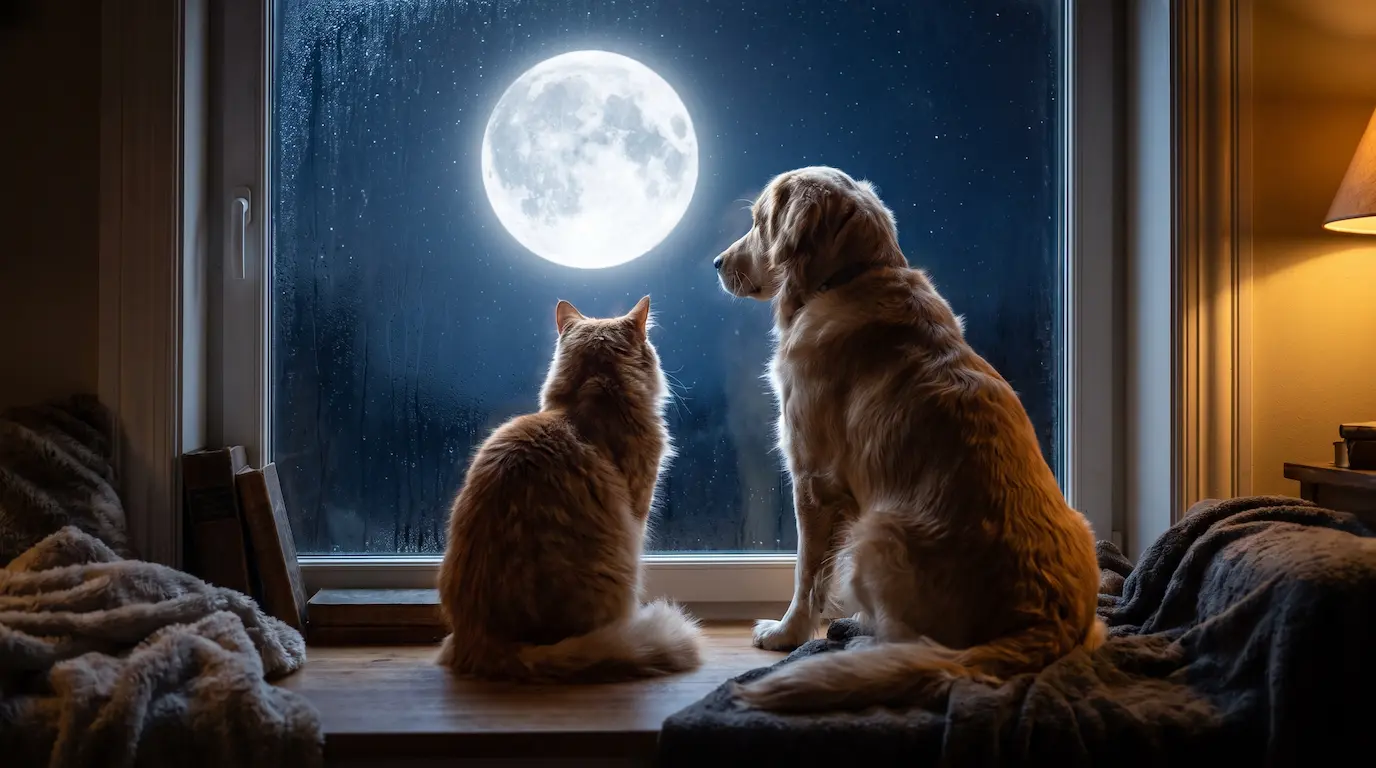
Yes — full moons do appear to affect cats and dogs, and the effect shows up in two ways at once. Veterinary emergency data has recorded a measurable rise in pet ER visits around the full moon, and owners consistently report restlessness, extra energy, and disrupted sleep. Astrology explains the pattern through the Moon itself — the ruler of instinct and emotion — which reaches peak intensity at the full moon and magnifies exactly the emotional wiring described by each pet's Moon sign.
Every pet owner has a full-moon story. The cat who tears through the house at 3 a.m. The dog who won't settle, paces the hallway, and barks at nothing. The sudden, collective restlessness that makes you glance out the window and notice the sky is bright and round. Coincidence? Maybe. But it's a coincidence that repeats, month after month, in households all over the world — and both science and astrology have something to say about why.
Do full moons actually affect pets? What the evidence shows
This isn't purely folklore. A frequently cited 2007 study out of Colorado State University, published in a veterinary journal, reviewed thousands of emergency-clinic visits and found that the risk of a pet needing emergency care was roughly 23% higher for cats and 28% higher for dogs on the days surrounding a full moon. That's a real, measurable signal in a large dataset.
The honest caveat: a correlation isn't a cause. Researchers point out that brighter full-moon nights simply mean more animals are outside, more active, and awake later — which naturally produces more scrapes, falls, and mishaps. In other words, the Moon may be changing behavior indirectly, through light and activity, rather than through any mysterious force. That's a fair and important point.
But notice what even the skeptical reading concedes: pets are measurably more active and more affected around the full moon. Whether you attribute it to lunar light, disrupted sleep, or something astrology has described for millennia, the underlying observation holds. Something shifts. The question astrology asks is not whether — but why, and why some pets feel it far more than others.
Why the Moon sits at the center of pet astrology
In astrology, the Moon has never been a minor player. It governs the inner life — emotion, instinct, memory, and the need for security. Where the Sun describes who a creature is, the Moon describes how they feel and react beneath the surface. For animals, who live far more by instinct than by reason, that makes the Moon arguably the single most important placement in the chart.
A full moon is simply the Moon at the height of its power — fully illuminated, at its most visible and, astrologically, its most amplifying. It doesn't introduce a new energy so much as turn up the volume on the one that's always there. Emotional sensitivity intensifies. Instinct sharpens. Whatever a pet's baseline reactivity is, the full moon tends to push it toward its extreme — which is exactly why the effect is so noticeable, and so different from one animal to the next.
- New Moon
- Waxing Crescent
- First Quarter
- Waxing Gibbous
- Full Moon
- Waning Gibbous
- Last Quarter
- Waning Crescent
Full moon and cats: the sign that feels it most
Cats are built to notice a full moon. They're crepuscular by nature — wired for the low light of dawn and dusk — and intensely sensitive to changes in illumination. A bright night sky reads to a cat as an invitation: heightened alertness, midnight activity, vocalizing at windows, and the full-throttle "zoomies" that send them careening through the house while you're trying to sleep.
Astrologically, cats are considered especially Moon-attuned. Their emotional world is interior and private — the very domain the Moon rules — which is why, in cat astrology, the Moon often matters even more than the Sun. At the full moon, that lunar sensitivity peaks. A cat who is normally serene may become restless and clingy; a cat who is normally independent may suddenly want to be everywhere you are, or nowhere near anyone. The cat Moon sign guide goes deeper into why the Moon is a cat's most telling placement.
Full moon and dogs: restlessness and reactivity
Dogs broadcast where cats filter, so a full moon in a dog tends to look like turned-up energy rather than quiet intensity. Owners report the same cluster again and again: a dog who can't settle, paces, whines, barks at sounds that wouldn't normally register, and seems generally wired. On bright nights, some dogs show a sharpened prey drive — more fixated on movement, more likely to bolt after it.
This tracks with both the emergency-visit data and the astrological view. In dog astrology, the Moon governs a dog's emotional regulation — how they process stress and return to calm. When the full moon amplifies that system, a dog's ability to self-soothe takes a hit, and the restlessness has to go somewhere. You can watch it change nightly on the daily dog horoscope, which tracks the Moon's real position and phase. To see which phase your own dog or cat was born under, put their birthday into the birth moon phase calculator.
The real reason two pets react so differently: their Moon sign
Here's the piece that explains why one cat sleeps through a full moon while another climbs the curtains. The full moon amplifies the Moon's energy — but which energy it amplifies depends entirely on your pet's individual Moon sign: the zodiac sign the Moon occupied at the moment they were born.
- Water Moons (Cancer, Scorpio, Pisces): The most sensitive. A full moon tends to spike emotional intensity — more clinginess, more absorbing of household stress, more need for reassurance. These are the pets who seem to feel the night.
- Fire Moons (Aries, Leo, Sagittarius): The most reactive. Expect turned-up energy, restlessness, and a shorter fuse. These pets need a physical outlet at the full moon, not soothing — a game, a walk, a way to burn it off.
- Earth Moons (Taurus, Virgo, Capricorn): The most grounded. Often the least visibly affected, though a disrupted routine or an over-bright sleeping spot can still unsettle them. Stability is their anchor.
- Air Moons (Gemini, Libra, Aquarius): The most mentally restless. A full moon shows up as scattered, buzzy, over-stimulated energy — pacing, chattering, unable to switch the brain off. Calm and gentle engagement help.
This is why a full moon is such a useful lens on your pet: it reveals their Moon sign in action. If you know the placement in advance, the monthly restlessness stops being a mystery and becomes something you can predict and prepare for. Aetris works out your pet's Moon sign from their birth date, and where no birth date exists, the Rectification AI estimates it from how your pet actually behaves.
Find Your Pet's Moon Sign
The full moon reveals your pet's Moon sign in action — clinginess, restlessness, or calm. Aetris works out their Moon sign from a birth date, and estimates it from behavior when there isn't one.
Get the App Free Try the free Calculator →What to do on full moon nights
Keep the routine steady. Predictability is the best counterweight to a full moon's restlessness. Same feeding times, same evening rhythm — a stable routine gives an over-stimulated pet an anchor to hold onto.
Front-load the energy. Extra play and exercise earlier in the day gives a wired pet somewhere to spend the surplus, so there's less left to fuel a 3 a.m. episode. This matters most for fire-Moon and air-Moon pets.
Dim the night. Block bright moonlight from sleeping areas with curtains or blinds. For a light-sensitive cat especially, cutting the illumination can quiet the instinct to treat a bright night as playtime.
Match the comfort to the sign. Sensitive water-Moon pets want reassurance and closeness; reactive fire-Moon pets want a physical outlet; grounded earth-Moon pets want their routine left alone. Knowing the Moon sign tells you which lever to pull.
Rule out the medical first. Genuine distress, pain, or a sudden dramatic behavior change is never "just the moon." If something seems truly wrong, the full moon is a footnote — call your vet.
The bottom line
Do full moons affect pets? The evidence says something real is happening — pets are measurably more active and more accident-prone around the full moon, and owners feel it every month. Astrology offers the framework that makes it make sense: the Moon rules instinct and emotion, the full moon turns that dial to maximum, and your pet's Moon sign decides exactly how the intensity comes out. Learn that one placement, and the wildest night of the lunar month becomes the most predictable.
Frequently Asked Questions
Does the full moon really affect pet behavior?
There is some evidence that it does. A frequently cited 2007 study of veterinary emergency visits found that the risk of a pet needing emergency care was around 23% higher for cats and 28% higher for dogs on days around the full moon. Researchers caution the cause isn't proven — brighter nights may simply mean more outdoor activity and more accidents — but many owners consistently report restlessness, extra energy, and disrupted sleep in their cats and dogs around the full moon. In astrology, this fits a long-held view that the Moon governs instinct and emotion, and that the full moon amplifies it.
Why is my cat so crazy during the full moon?
Cats are naturally crepuscular and highly sensitive to light, so a bright full-moon night can trigger extra alertness, night activity, vocalizing, and the "zoomies." Astrologically, cats are considered especially Moon-attuned — their emotional world is interior and lunar — so the full moon's peak intensity tends to show up as restlessness or clinginess. A cat's individual Moon sign shapes exactly how they react: water-Moon cats get more sensitive and clingy, fire-Moon cats get more reactive and wild.
How does the full moon affect dogs?
Owners commonly report that dogs become more restless, more reactive, more vocal, and harder to settle around the full moon, with some noticing a heightened prey drive on bright nights. The same veterinary emergency data showed a measurable rise in dog ER visits near the full moon. In astrology, the full moon amplifies the Moon's domain — emotion and instinct — so a dog's baseline sensitivity spikes. How strongly depends on their Moon sign: fire and cardinal Moons tend to react most intensely.
What is a pet's Moon sign and why does it matter at the full moon?
A pet's Moon sign is the zodiac sign the Moon was in when they were born, and in astrology it governs their emotional instincts — how they handle stress, seek comfort, and react to change. Because the full moon is the Moon at peak power, it magnifies exactly the emotional pattern the natal Moon sign describes. That's why two pets react to the same full moon completely differently. Apps like Aetris calculate your pet's Moon sign from their birth date, or infer it from behavior when no birth date is known.
How can I calm my pet during a full moon?
Keep the routine predictable, add extra play earlier in the day to burn off energy, dim the home and block bright moonlight from sleeping areas, and offer a calm, secure retreat. For sensitive water-Moon pets, extra reassurance helps; for reactive fire-Moon pets, more physical outlet helps. Knowing your pet's Moon sign lets you anticipate whether they'll need soothing or a way to discharge energy.