Pet Birth Chart: How to Read Your Dog or Cat's Natal Chart
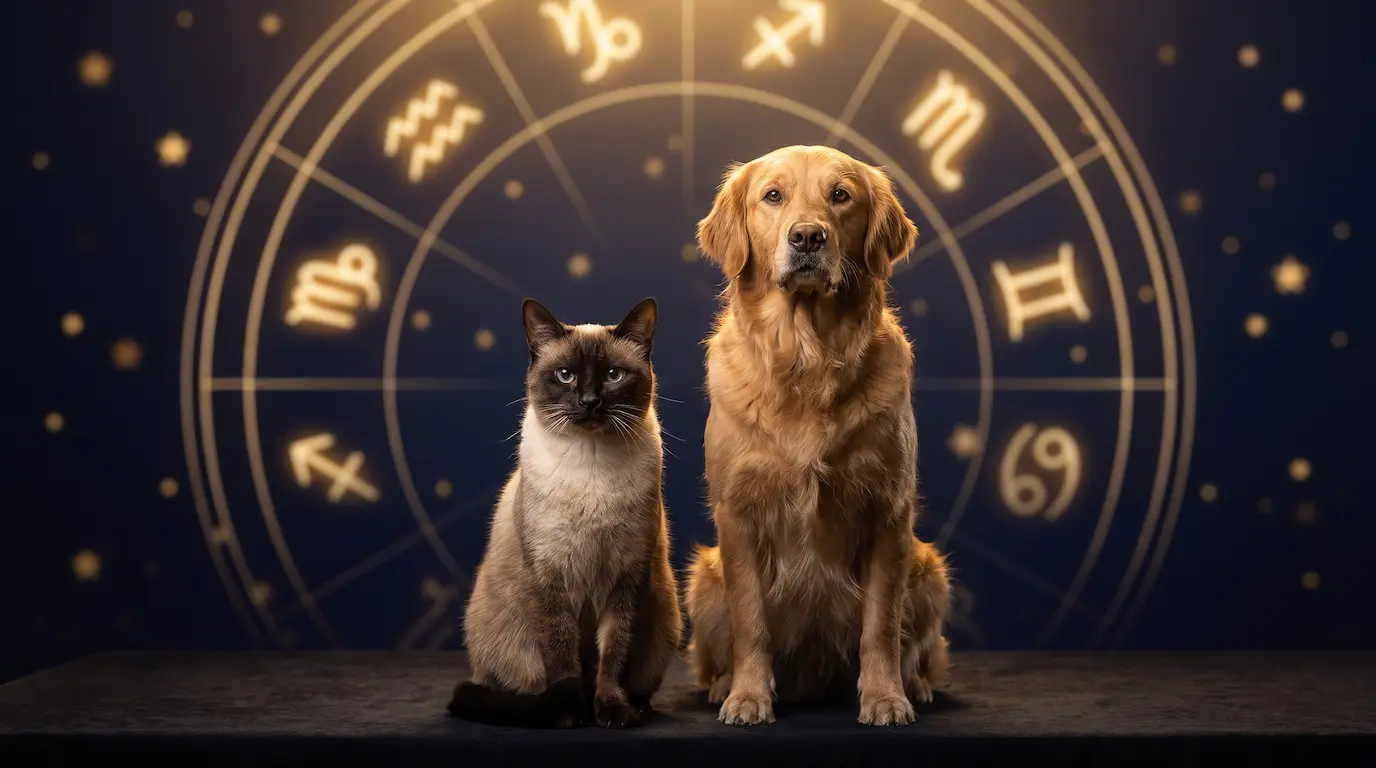
Most people meet pet astrology through a single fact: their dog is a Leo, their cat is a Scorpio. That Sun sign is a real starting point — but it's one placement out of a dozen. A pet birth chart is the whole picture: a snapshot of where the Sun, Moon, and every planet sat in the sky at the exact moment your animal was born. It's the difference between knowing a dog is "a Leo" and understanding why that particular Leo panics in the car but sleeps through fireworks.
This guide walks through what a pet natal chart actually contains, how to read the three placements that matter most, and how to generate one for your own dog or cat from nothing more than a birth date. No astrology background required.
"I thought Biscuit was just a stubborn Taurus. Then I saw his chart — Taurus Sun, but Aries Rising and a Pisces Moon. Suddenly the bravado-then-meltdown pattern made complete sense."
What a Pet Birth Chart Actually Is
A birth chart — the terms natal chart and birth chart are interchangeable — is a circular map of the sky frozen at one moment: your pet's birth. Around that circle sit the twelve zodiac signs, and plotted onto them are the Sun, the Moon, and the planets, each in the sign it occupied that day. The chart is calculated from three inputs: the birth date, the birth time, and the birth location.
Each placement answers a different question about your animal. The Sun asks who are they at the core? The Moon asks what do they need to feel safe? The Rising sign asks how do they react before they think? The other planets add texture — how they play, how they bond, where they get defensive. A Sun sign gives you a headline. The full chart gives you the article.
This is why two dogs born the same week can be so different. They share a Sun sign, but a few days' difference moves the Moon, and a few hours moves the Rising sign entirely. The chart captures what makes your specific animal specific.
The Big Three: Sun, Moon, and Rising
If you read nothing else in a pet's chart, read these three. Astrologers call them the "Big Three" because together they account for most of what you actually observe day to day.
The Sun is the personality your pet grows into: their default temperament when they're comfortable, confident, and being themselves. It's the placement you already know, and the only one you can find from the birth date alone. Think of it as the through-line of who they are across their whole life.
The Moon governs the inner emotional world: how your pet handles stress, forms attachments, and what conditions let them fully relax. It changes signs every two to three days, so it's far more specific to your animal than the Sun. When behavior "doesn't match the personality," the Moon is usually the reason.
The Rising sign, or Ascendant, is the instinctive mask: the first thing a stranger sees and the reflex your pet leads with before thinking. It changes roughly every two hours, so it needs an accurate birth time. A shy-core Cancer with a Leo Rising will greet the room like they own it, then need a nap to recover.
The magic isn't in any single placement — it's in the combination. A Sagittarius Sun with a Cancer Moon is adventurous on the surface but needs emotional continuity underneath. Layer in the Rising sign and you have a temperament fingerprint no Sun sign could ever capture on its own.
Beyond the Big Three: The Other Placements
Once you've got the Big Three, the rest of the chart fills in the detail. You don't need to memorize these, but knowing they exist explains a lot of otherwise puzzling behavior.
Mercury shapes how your pet communicates and learns — whether they pick up commands fast (Mercury in a quick air sign) or need patient repetition (Mercury in a fixed earth sign). Venus governs affection and pleasure: how they show love, whether they're a lap-cuddler or a respectful-distance companion, and what treats or textures they gravitate toward. Mars is drive and defensiveness — the placement behind the prey instinct, the guarding, and how they handle a challenge from another animal.
The chart also divides into twelve houses, which describe where in life each energy shows up — home, play, companionship, territory. For most owners the houses are a second-pass detail, useful once the Big Three already make sense. The point isn't to become an astrologer; it's to have a language for the patterns you already see.
How to Read Your Pet's Chart in Four Steps
Here's the practical order of operations once you have a chart in front of you:
1. Start with the Sun sign — establish the baseline personality. This is the story everyone tells about your pet, and it's usually accurate as far as it goes.
2. Add the Moon sign — now ask what they need emotionally. This is where you'll find the explanation for the anxiety, the clinginess, or the surprising resilience that the Sun sign didn't predict.
3. Layer in the Rising sign — this tells you how the first impression differs from the core. A big gap between Sun and Rising is why some pets "aren't what they seem" at the shelter versus at home.
4. Look for the tension — the most useful readings come from where placements pull against each other. A confident fire Sun with a cautious earth Moon is a pet who wants to be brave but needs a stable base to do it. That tension is the real personality.
Dog Charts vs. Cat Charts
The astronomy behind a dog birth chart and a cat birth chart is identical — the same planetary positions apply to every creature born on a given date. What changes is emphasis.
If you already know the birth date, the species calculators do the arithmetic and read the result through the right lens: the dog birth chart calculator interprets each sign through pack position, greeting and training, while the cat birth chart calculator reads it through territory, height and handling.
In dogs, the Rising sign tends to dominate visible behavior. Dogs live outwardly; how they greet, react, and present is a huge part of who they are, so the Ascendant carries real weight. That's why a dog's first impression can differ so sharply from their settled temperament.
In cats, the Moon sign often matters more. So much of a cat's life is internal — where they feel safe, who they trust, when they choose to appear — that the emotional placement frequently outranks the outward mask. A cat's chart is read from the inside out. If you want to go deeper on either, the dog Moon sign guide and the cat Moon sign guide break down all twelve emotional placements species by species.
How to Get Your Pet's Birth Chart
You don't need to draw the chart by hand — the calculation is pure astronomy, and an app does it in seconds. You need three things, in descending order of importance:
Birth date (required) — this alone gives you the Sun sign and a good estimate of the Moon. Birth time (ideal) — this unlocks the Rising sign and pins the Moon precisely. Birth location (helpful) — this fine-tunes the house placements. With all three, you get the complete natal chart.
If you know your pet's birthday, the free pet zodiac calculator gives you the Sun sign instantly. For the rest of the chart, Moon and Rising read for your specific dog or cat, the Aetris app works out the Moon from the date and writes the reading up in plain language.
Frequently Asked Questions
What is a pet birth chart?
A pet birth chart, or natal chart, is a map of where the Sun, Moon, and planets were positioned at the moment your dog or cat was born. It goes beyond the single Sun sign to describe their full temperament: the Sun sign for core personality, the Moon sign for emotional needs, and the Rising sign for how they react on instinct. Together these placements explain behavior that a Sun sign alone cannot.
How do I calculate my pet's birth chart?
You need your pet's birth date, and ideally an approximate birth time and location. Enter these into a pet astrology app like Aetris, which calculates the exact planetary positions for that moment and generates the full chart. The free Aetris pet zodiac calculator gives you the Sun sign instantly from the birth date alone.
Do I need my pet's birth time for a natal chart?
The Sun sign only needs the birth date. The Moon sign needs the date and benefits from an approximate time, since the Moon changes signs every two to three days. The Rising sign requires an accurate birth time because it changes roughly every two hours. If you don't know the time — common with rescue pets — Aetris's Rectification AI estimates it from behavioral patterns.
Is a dog birth chart different from a cat birth chart?
The astronomy is identical — the same Sun, Moon, and planetary positions apply to any birth on that date. What differs is interpretation. In dogs, the Rising sign tends to dominate visible behavior; in cats, the Moon sign carries more weight because so much of a cat's life is internal and emotional. Aetris tailors the reading to the species.
Build Your Pet's Birth Chart
Aetris works out your dog or cat's Sun and Moon from their birth date, adds the Rising, and writes the reading up in plain language. No birthday? The Rectification AI estimates it from behavior. Free on Android.
Get Your Pet's Birth Chart — Free Try the free Calculator →