How to Find Your Rising Sign

To find your rising sign you need three things, not one: your birth date, your birth time to the minute, and your birth town. The rising sign — the Ascendant — is the zodiac degree climbing over the eastern horizon at that exact moment in that exact place, and it moves into a new sign roughly every two hours. This guide covers where each piece is actually recorded, how precise you need to be, and what the answer means once you have it.
What the Rising Sign Actually Is
Most descriptions of the Ascendant start with personality. Start with geometry instead, because the personality part only makes sense once you can see the mechanism.
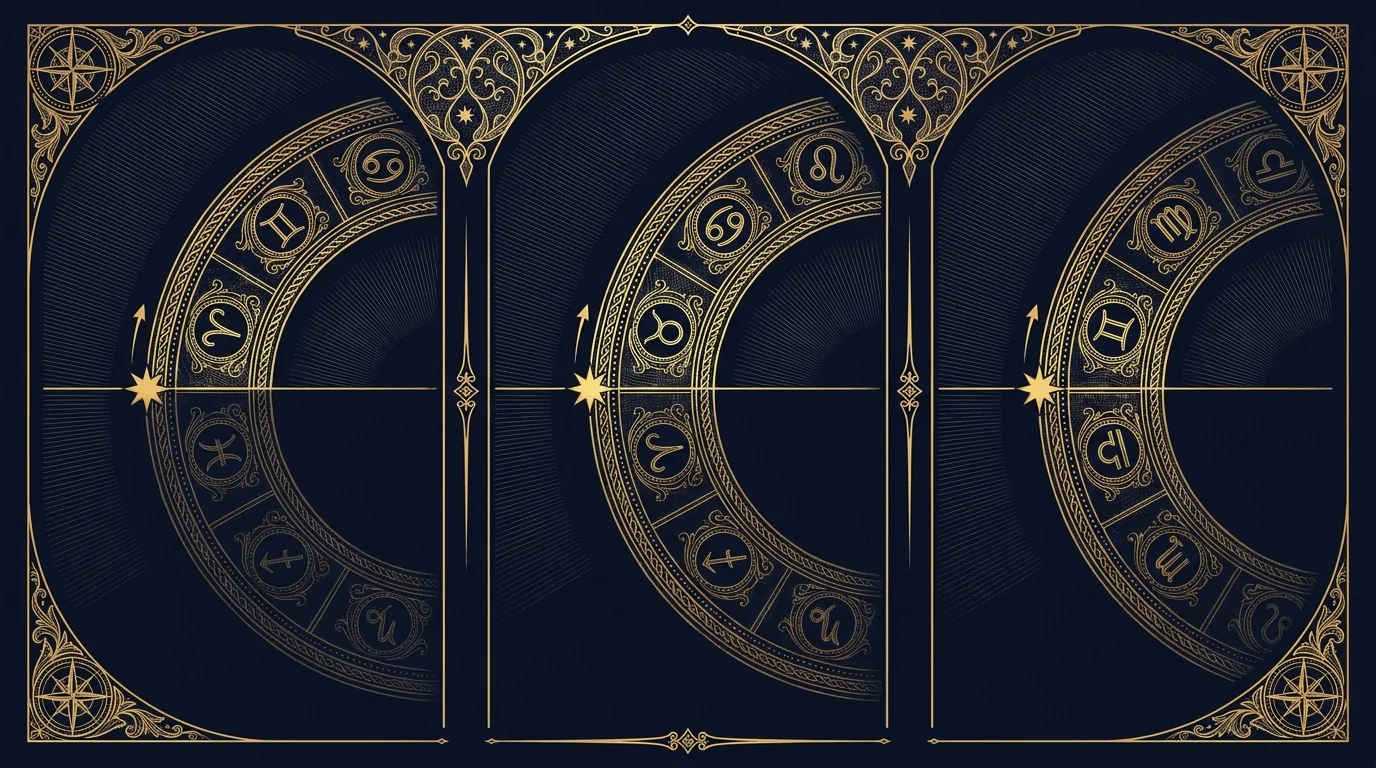
Stand outside at any moment and look east. The zodiac is a band circling the sky, and because the Earth turns, that band is continuously rolling up over the eastern horizon — one sign clearing the edge, the next coming up behind it, all day and all night. Your rising sign is simply whichever degree of that band was crossing the horizon at the instant you were born, seen from the spot on Earth where the birth happened.
That is why it needs so much more information than the rest of your chart. Your Sun sign asks where the Sun was, and the Sun barely moves in a day. Your Ascendant asks where you were standing and which way the planet had turned — a question that changes answer every few minutes.
The Three Things You Need
The date. Straightforward, and you already have it.
The time, to the minute. This is the piece that stops most people, and the next two sections are about getting it.
The place — town or city, not country. This one gets skipped and it matters. The horizon depends on your latitude and longitude, so two babies born at the identical instant, one in Lisbon and one in Helsinki, do not share a rising sign. Latitude has a second effect people rarely hear about: the further from the equator, the more unevenly the signs rise. Near the poles some signs heave over the horizon in well under an hour while their opposites take four. The "roughly two hours per sign" rule is an average, not a promise.
Where Your Birth Time Is Recorded
People give up on this too early, usually because they checked one document and found nothing. There are more places to look than most realise.
The long-form birth certificate. This is the big one. Many countries issue two versions: a short certificate for everyday identification, and a long-form or full certificate that reproduces the original register entry. The hour is frequently on the long form and almost never on the short one. If you looked at a wallet-sized card and saw no time, you have not actually checked yet.
Hospital records. Maternity units record the time of delivery as a clinical matter. Retention periods vary widely, and older records may have been destroyed or archived off-site, but a written request is often free and sometimes successful.
Family paper. Baby books, hospital bracelets, congratulation telegrams, newspaper birth announcements and the flyleaf of a family bible have all preserved birth times that no registry kept. This is where people most often find the answer they had given up on.
Whoever was there. Useful, with a caveat that deserves its own section — below.
Worth saying plainly: whether the hour appears on an official record depends on the country and often the region, and the rules have changed over time. A blank field on your certificate tells you what that registry recorded. It does not tell you that nobody wrote the time down.
How Precise the Time Has to Be
Here is the arithmetic that decides whether a remembered time is good enough.
The horizon sweeps through the full three hundred and sixty degrees of the zodiac in twenty-four hours. That works out at one degree every four minutes, and — on average — one whole sign every two hours.
So: a five-minute uncertainty moves your Ascendant by about a degree, which almost never changes the sign. Twenty minutes moves it five degrees, which changes the sign only if you were already sitting near the boundary. An hour moves it half a sign, and if you began anywhere in the second half of a sign, you have just been relocated into the next one.
This is why "she thinks it was around three in the afternoon" is a starting point rather than an answer. Remembered times cluster on round numbers — people recall three o'clock far more often than 3:17 — so a memory carries a built-in bias toward the hour and half-hour, not just noise around the truth.
The practical test: once you have a result, recalculate it with the time moved thirty minutes earlier and thirty minutes later. If all three runs give the same sign, your Ascendant is robust and you can stop worrying. If they disagree, you are near a cusp and the exact minute genuinely matters before you build anything on it.
Finding It, Step by Step
- Get the time from a document if you possibly can — long-form certificate first, then hospital records, then family paper.
- Write down the town, not the country — and if you were born in a large metropolitan area, the specific municipality is better than the metro name.
- Enter date, time and place together into a chart calculator and read off the Ascendant.
- Run the thirty-minute test in both directions and note whether the sign holds.
- If the sign moves, record both rather than picking the one you prefer. Reading two descriptions honestly is more useful than committing to a coin flip.
Why Two Calculators Can Disagree
It happens often enough to be worth explaining, because the instinct is to assume one tool is broken.
Different coordinates for the same place name. Town names repeat, and databases resolve them differently. A birth in one Springfield is not a birth in another.
Different historical time zone handling. This is the big one. Daylight saving rules have been rewritten repeatedly, countries have shifted their standard offsets, and several ran wartime clock changes that lasted years. A calculator that applies today's rules to a birth decades ago can be a full hour out — which, as established above, is enough to move the sign.
You are genuinely near a cusp. If your Ascendant sits within a couple of degrees of a boundary, any small difference in the first two points tips it over. The disagreement is not a bug; it is the tools honestly reporting a knife-edge.
What Your Rising Sign Means
Now the part everyone came for.
The three placements people talk about most divide the job between them. The Sun is the core character — the thing you are being when nothing is asking anything of you. The Moon is the private register — what you need in order to feel safe, and the mood you fall back to when nobody is watching. The Ascendant is the doorway: your pace, your opening move, and the shorthand a stranger would use to describe you after five minutes.
This is why the rising sign gets attention out of proportion to being one placement among many. It is the layer other people meet first, so it is the one most likely to be mistaken for the whole of you — and the one most likely to make you feel that your Sun sign description misses.
It carries a second job as well. The Ascendant is the anchor the house system is built from, which means it decides which area of life every other placement operates in. Without it you can know that Venus was in Libra; with it you also learn which department that Venus was posted to — the one handling income, or the one handling marriage, or the one that governs what happens behind your own front door. One placement, and it reorganises the reading of everything else.
If the Moon layer is the one you want next, our Moon sign guide sits on the pet side of this site, but the twelve descriptions in it are ordinary astrology and read the same for a person. And the guide to reading a full chart walks through how the three layers stack.
If the Hour Is Gone for Good
Sometimes the certificate has a blank, the hospital has nothing, and everyone who was in the room has died. That is a real ending, and it is worth being straight about it: there is no method that recovers a rising sign from a birth date. The horizon covers all twelve signs every day, so a date narrows twelve possibilities to twelve.
Two things are still true, though.
The first is that the rest of your chart is unaffected. Your Sun is certain, your Moon is certain on most dates and narrowed to two on the rest, and every planet still has a known sign. We wrote a separate guide on exactly what a birth chart without a birth time gives you, including the arithmetic behind the Moon.
The second is that you should be suspicious of anything that hands you an Ascendant anyway. Many calculators accept a blank time field, quietly substitute noon, and print a rising sign and twelve house cusps with no marker saying so. If you never entered a time and a rising sign appeared, it was assumed.
How Aetris handles it: a birth date is all it needs to begin. The full chart screen adds your birth place and leaves the hour as an optional field — fill it in and your Ascendant is calculated properly; leave it blank and nothing is quietly substituted in its place. We build charts for rescue animals who arrive with no paperwork at all, so working honestly with missing data is the ordinary case for us rather than an edge case.
Read Your Full Chart — Free on Android → On iPhone? Aetris is on Android today — join the iOS list →Frequently Asked Questions
What is a rising sign?
Your rising sign, also called the Ascendant, is the zodiac sign that was climbing over the eastern horizon at the exact moment and place you were born. The Sun sign describes character and the Moon sign describes what you need privately, but the rising sign describes your manner of arrival — the impression that lands before anyone has enough information to correct it, and the anchor the rest of the chart is organised around.
What do I need to find my rising sign?
Three things: your birth date, your birth time to the minute, and your birth town or city. The date and time set the moment, and the place sets the horizon. Country alone is not enough, because the horizon shifts with latitude and longitude — two people born at the same instant in different cities can have different rising signs.
How accurate does my birth time need to be?
More accurate than most people expect. The Ascendant advances about one degree every four minutes, and it crosses into a new sign roughly every two hours. A twenty-minute error will usually leave you in the same sign but shift the degree; an hour's error can move you into the next sign entirely. If your only source is someone's memory of the afternoon, treat the result as provisional.
Where is my birth time recorded?
The most common sources are the long-form birth certificate, which lists the hour where the short-form version usually does not, the hospital's own maternity records, and family keepsakes such as a baby book or an announcement card. Whether the time appears on an official record depends on the country and often the region, so the short certificate showing no hour does not mean no hour was ever written down.
Can I find my rising sign without a birth time?
No. The rising sign is the one placement that a birth date cannot narrow at all, because the horizon travels the entire zodiac every twenty-four hours. Any tool that returns a rising sign from a date alone has assumed a time, usually noon. The rest of your chart is still readable without the hour, which is a different question and worth separating from this one.
Why do two calculators give me different rising signs?
Usually one of three reasons. The birth place was resolved to different coordinates, the historical time zone was applied differently — daylight saving rules have changed repeatedly and wartime clock shifts catch calculators out — or you sat close enough to a cusp that a small difference in either flipped the sign. Check that both tools used the same town and the same offset before assuming either is broken.
Three Layers, One Chart
Aetris reads your Sun, your Moon and — when you have the hour — your Ascendant, alongside a daily horoscope in four parts. If your birth time is missing, nothing is fabricated to cover it.
Read Your Three Layers — Free On iPhone? Join the iOS List No birth time? Read this next →