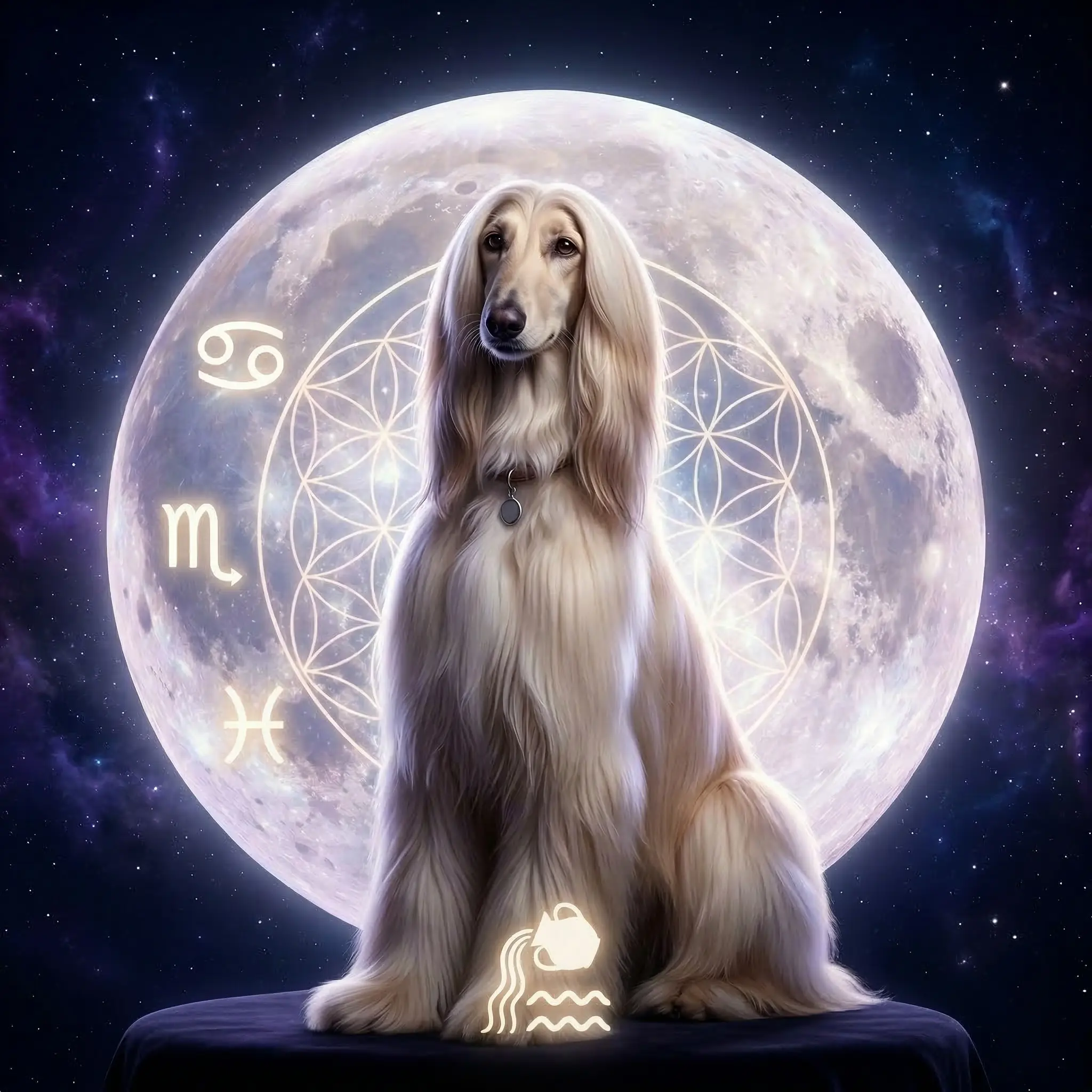
The Sun sign explains your dog when everything is fine. The Moon sign explains your dog when it isn't. In dog astrology, the Moon governs how they process fear, where they anchor their sense of security, what they need in order to feel truly settled - and why they sometimes react to nothing visible at all.
If you've ever thought, "This doesn't match their personality," the Moon sign is usually the answer. The dog that tests as sociable and outgoing (Leo Sun) but hides under the bed during parties (Scorpio Moon). The confident Aries who falls apart in a new home (Cancer Moon). The placid Taurus that becomes anxious around argument (Libra Moon). The Sun tells you who they are. The Moon tells you what they need.
"Mango is a Gemini - curious, bouncy, never stops moving. But she shuts down completely when her routine breaks. We didn't understand until we saw her Moon in Taurus. That was it exactly."
What the Moon Sign Actually Controls
In astrology, the Moon governs the inner emotional world - not what we show, but what we feel. In dogs, this translates into their attachment style, their stress responses, and the conditions under which they feel safe enough to fully relax.
The Moon changes signs approximately every two and a half days, which means it requires a more precise birth date than the Sun sign - and, ideally, an approximate birth time. For rescue dogs with unknown dates, Aetris's Rectification AI can infer probable Moon placements from behavioral data. But if you know when your dog was born, this guide will help you understand what you're seeing.
All 12 Dog Moon Signs
Emotional responses are immediate and intense - and forgotten almost as quickly. Moon-in-Aries dogs don't hold grudges, but they also don't process slowly. They can seem erratic during stressful periods, but they typically bounce back faster than any other placement. They need an outlet, not reassurance.
Deeply affected by physical disruption. A new food, a different walking route, rearranged furniture - each change costs them something. They don't adapt quickly and shouldn't be pushed to. Their emotional ground is their physical environment: calm the space, calm the dog. Exceptionally loyal once a stable home is established.
Emotionally curious rather than emotionally deep. They adapt quickly, recover quickly, and don't get stuck in grief the way other placements do. The risk is that they need constant mental stimulation to stay balanced - a Moon-in-Gemini dog left with nothing to do doesn't just get bored, they get anxious.
The Moon rules Cancer, making this its most powerful placement. Moon-in-Cancer dogs don't just attach - they merge. Any disruption to their primary bond triggers real behavioral shifts: changes in appetite, sleep, even physical health. They need to know you're coming back. Consistent goodbyes and returns matter more than most people realize.
Emotionally needs to be seen. This isn't vanity - it's a genuine need for acknowledgment that maps onto how they process safety. A Moon-in-Leo dog that feels consistently overlooked can develop attention-seeking behavior that baffles owners. Ignoring them as a disciplinary tool works precisely because they understand what it means.
Moon-in-Virgo dogs feel emotionally safe through predictability. They need to know what comes next. Unpredictable environments are genuinely destabilizing for them, not just uncomfortable. They're often the dogs described as "nervous" for no obvious reason - the reason is usually structural, not event-specific. Consistent routines are their medicine.
Deeply uncomfortable with tension. Their emotional well-being is genuinely tied to the peace of the household - not as a metaphor. Moon-in-Libra dogs may become physically distressed during prolonged conflict between their humans. They often attempt to mediate. Households with frequent arguments are genuinely hard environments for them.
Emotions run deep and hold long. Moon-in-Scorpio dogs do not forget - not the betrayal, not the abandonment, and not the kindness. They form attachments that feel almost possessive, with the one person who has proven trustworthy over time. The trust is difficult to earn and impossible to fake. Once earned, nothing breaks it.
Emotionally resilient and innately optimistic. They don't need much processing time after stress - they move forward. But confine them too long, physically or emotionally, and they destabilize. Freedom isn't a preference for Moon-in-Sagittarius dogs; it's a requirement. Crates, small apartments, and rigid schedules work against them.
Doesn't show distress easily - which means it can accumulate unnoticed. Moon-in-Capricorn dogs need consistency above everything. They're not particularly demonstrative, which owners sometimes misread as contentment when the dog is actually suppressing. Watch for physical signals: a subtle change in appetite or sleep is often the first sign something's wrong.
Processes emotion differently, rather than more shallowly. Moon-in-Aquarius dogs can seem unbothered in situations other dogs find distressing - not because they don't feel it, but because they route it differently. They need intellectual engagement and variety as emotional maintenance. Routine without novelty makes them quietly restless.
Absorbs the emotional state of the household completely. If you're anxious, they're anxious - before you've recognized it yourself. If you're grieving, they're at your side before you've asked. This is the most emotionally intuitive placement, and the most easily overwhelmed. They need periods of genuine calm to discharge what they've absorbed from the people around them.
Reading Sun and Moon Together
The Sun-Moon combination is where individual personality becomes specific. A Sagittarius Sun with a Cancer Moon is a dog who appears adventurous and outgoing but secretly needs emotional continuity to function. They'll run free all day, but they need to know exactly who they're coming home to.
A Scorpio Sun with a Gemini Moon is a dog who seems intense and selective on the surface but recovers from emotional disruption faster than you'd expect. They still remember - but they don't stay stuck.
These combinations are why two dogs of the same Sun sign can behave so differently. Dog horoscope signs are rarely just one placement - they're a conversation between Sun, Moon, and Rising. The Moon sign is the variable most people aren't accounting for.
Frequently Asked Questions
What is dog astrology?
Dog astrology is the practice of applying astrological principles to dogs - calculating their natal chart based on birth date, time, and location to understand their personality, emotional needs, and behavioral patterns. A dog's chart includes three primary placements: the Sun sign (core personality), Moon sign (emotional life), and Rising sign (instinctive reactions).
What is a dog's moon sign?
A dog's moon sign is the zodiac sign the Moon was in at the moment of their birth. In dog astrology, the Moon governs emotional processing - how a dog handles stress, forms attachments, and feels secure. Unlike the Sun sign which changes every 30 days, the Moon changes signs every 2–3 days, making it more specific to your dog's exact birth date.
How do I find my dog's moon sign?
To find your dog's moon sign, you need their exact birth date and ideally an approximate birth time. Enter this into an astrology app like Aetris, which calculates the Moon's position for that moment. For rescue dogs with unknown birth dates, Aetris's Rectification AI can infer the probable Moon sign from behavioral patterns.
How is a dog's moon sign different from their sun sign?
The Sun sign describes a dog's core personality - who they are when comfortable and confident. The Moon sign describes their emotional inner world - how they process fear, form bonds, and what they need to feel truly safe. Two dogs with the same Sun sign can behave very differently if their Moon signs differ.
Find Your Dog's Moon Sign
Aetris calculates your dog's full natal chart including the Moon sign. Enter their birth date for an exact reading - or use behavioral data if you don't know it. Free for iOS and Android.
Get the App Free