What Moon Phase Were You Born Under?
Enter a birth date and see the Moon exactly as it was that day: its phase, how much of it was lit, how far into its cycle it had travelled and which sign it stood in.
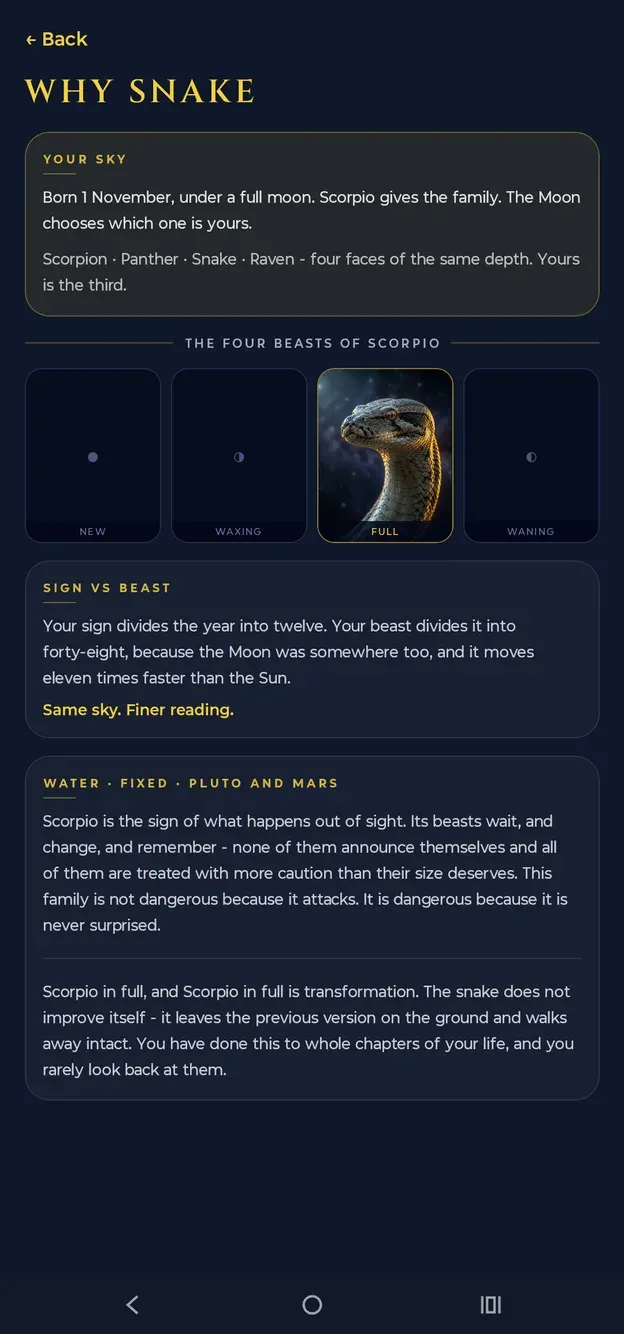
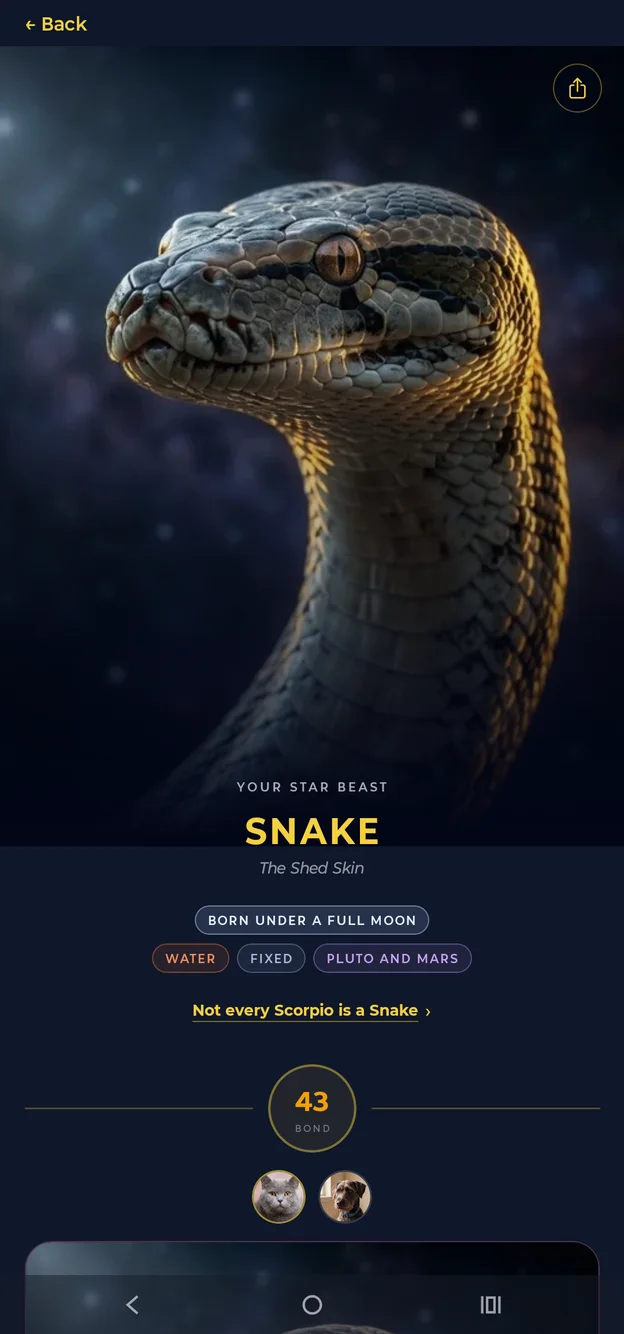
Your birth moon has a face in the app
- Your Star Beast — one of forty-eight, set by your Sun sign and the quarter of the cycle you were born in, with the reason it is yours
- Your pet’s Star Beast, and Kindred: your beast and theirs read side by side
- Your own Human Oracle — a free daily horoscope written for you
- A daily horoscope for your dog or cat, written around their Sun, Moon and Rising
What Moon Phase Was I Born Under?
A moon phase is an angle. Seen from Earth, the Moon sits somewhere between zero and 360 degrees ahead of the Sun, and that angle decides how much of its sunlit half faces us.
At zero the two rise together and the Moon is dark; at 180 it stands opposite the Sun and is full. The calculator above finds that angle for your birth date from the real positions of the Sun and the Moon, then names the phase, so the answer is the sky you were actually born under rather than a value read off a printed calendar.
The eight phases of the Moon
Four of the eight are moments, not stretches. The New Moon, First Quarter, Full Moon and Last Quarter each happen at a single instant, which is why a calendar gives each of them one date. The four between them usually run six or seven days apiece.
- New Moon the Moon lines up with the Sun and the side facing us is dark
- Waxing Crescent a thin lit edge returns in the evening sky
- First Quarter half the disc is lit, a quarter of the way round
- Waxing Gibbous more than half lit and still growing
- Full Moon opposite the Sun, the whole face lit
- Waning Gibbous the light begins to shrink
- Last Quarter half lit again, on the other side
- Waning Crescent a last sliver before the next new moon
A full cycle from one new moon to the next takes about 29.5 days. The “Moon age” in your result is how many of those days had passed since the last new moon.
How this calculator finds your birth phase
It computes the ecliptic longitude of the Sun and of the Moon with the standard series from Jean Meeus’s Astronomical Algorithms, widely used in almanac and planetarium code. The Moon’s position stays within about a hundredth of a degree of the complete series, and the principal phases land within a couple of minutes of published tables.
Your date is read as a calendar day in your own time zone, midnight to midnight. If a principal phase became exact that day, the day takes its name and the result gives the time. If one fell within a few hours of either midnight, the result says so, because a birth in another time zone would put it on a different date.
Moon phase vs Moon sign
- The Moon’s angle to the Sun
- Sets how much of it is lit
- Repeats every 29.5 days
- The Moon’s place in the zodiac
- Changes about every 2.5 days
- Full round in about 27.3 days
They are two different measurements of the same Moon. The phase is its angle to the Sun, which sets the shape of the light. The sign is the section of the zodiac it is passing through, and it moves on to the next one roughly every two and a half days.
So two people born a week apart can share a moon sign and have opposite phases, and two people born a month apart can share a phase under different signs. The result shows both, and flags the days when the Moon changed sign, since on those the birth time decides which sign counts.
What your birth moon phase means
Reading character from the phase at birth belongs to a tradition called the lunation cycle, popularised in the twentieth century by the astrologer Dane Rudhyar. It treats the month as one story, from a dark beginning through a full, outward peak to a quiet ending, and reads a birth by where in that story it falls.
It is worth being clear about which half is which. The phase on this page is astronomy and is calculated exactly. What a phase says about a person is interpretation, offered here in that tradition’s terms, so use it as a lens, not a verdict.
From birth moon to Star Beast
Aetris uses the birth moon too. Your Sun sign picks a family of four animals and the quarter of the lunar cycle you were born in picks which one is yours, twelve signs by four quarters, forty-eight Star Beasts in all.
The app counts the cycle in four broad quarters rather than eight phases, so the two do not always share a name: a birth under a waxing gibbous Moon can already count as a full-quarter Star Beast. The result above shows both, side by side.
Your pet’s birth moon
Switch the form to “For my pet” and the same calculation runs for a dog or cat. If you are curious whether the Moon changes how animals behave, the evidence is more mixed than the folklore, and our look at full moon pet behavior goes through it. No birth date for a rescue? Astrology for rescue animals covers what you can still work out.
What Each Birth Moon Phase Means
The eight readings of the lunation tradition, in the order the Moon passes through them. Your result above shows the one for your date.
Born at the New Moon
Sun and Moon rose together and the night was dark. The tradition reads this as an instinctive nature that acts first and explains later, more at home starting things than finishing them, and often understood by others only after the fact.
Born at the Waxing Crescent
The first thin light had just returned. This is the phase of pushing against inertia: a quietly determined nature that keeps building toward something nobody else can see yet, and tends to underestimate how far it has already come.
Born at the First Quarter
Half the disc was lit and the Moon stood a quarter-circle ahead of the Sun. The tradition calls it a crisis in action: a decisive, practical nature that likes a problem to push against and has little patience for plans that stall.
Born at the Waxing Gibbous
Nearly full, not quite there. Births under the gibbous Moon are read as perfecters, always asking how the thing could be better, deeply devoted to whatever earns their attention and, on a bad day, their own harshest critic.
Born at the Full Moon
The Moon stood opposite the Sun and the whole face was lit. This is the most visible phase in the cycle, read as a nature that comes to know itself through other people, feels pulled between two directions and does its best work in the open.
Born at the Waning Gibbous
The light had just begun to shrink. Rudhyar called this the disseminating Moon: a nature that wants to pass on what it has learned, talks its convictions through and tends to end up explaining things to a room, invited or not.
Born at the Last Quarter
Half lit again, this time on the other side. The last quarter is read as a turning point in outlook: a principled, sometimes contrary nature that would rather rebuild from the ground up than keep something that no longer works.
Born at the Waning Crescent
Only a last sliver remained before the dark. Called the balsamic Moon, it is read as a reflective, inward nature that seems to sense how stories end: better at endings than beginnings, and already clearing ground for what comes next.
- Spirit animal by zodiac sign the twelve families behind the Star Beasts
- Birth chart without a birth time what a date alone can and cannot settle
- How to find your rising sign the one placement that needs the hour
- Dog moon sign guide the Moon's sign, read for dogs
- Cat moon sign guide and why it matters more in cats
- Pet zodiac calculator a pet's Sun sign from a birth date